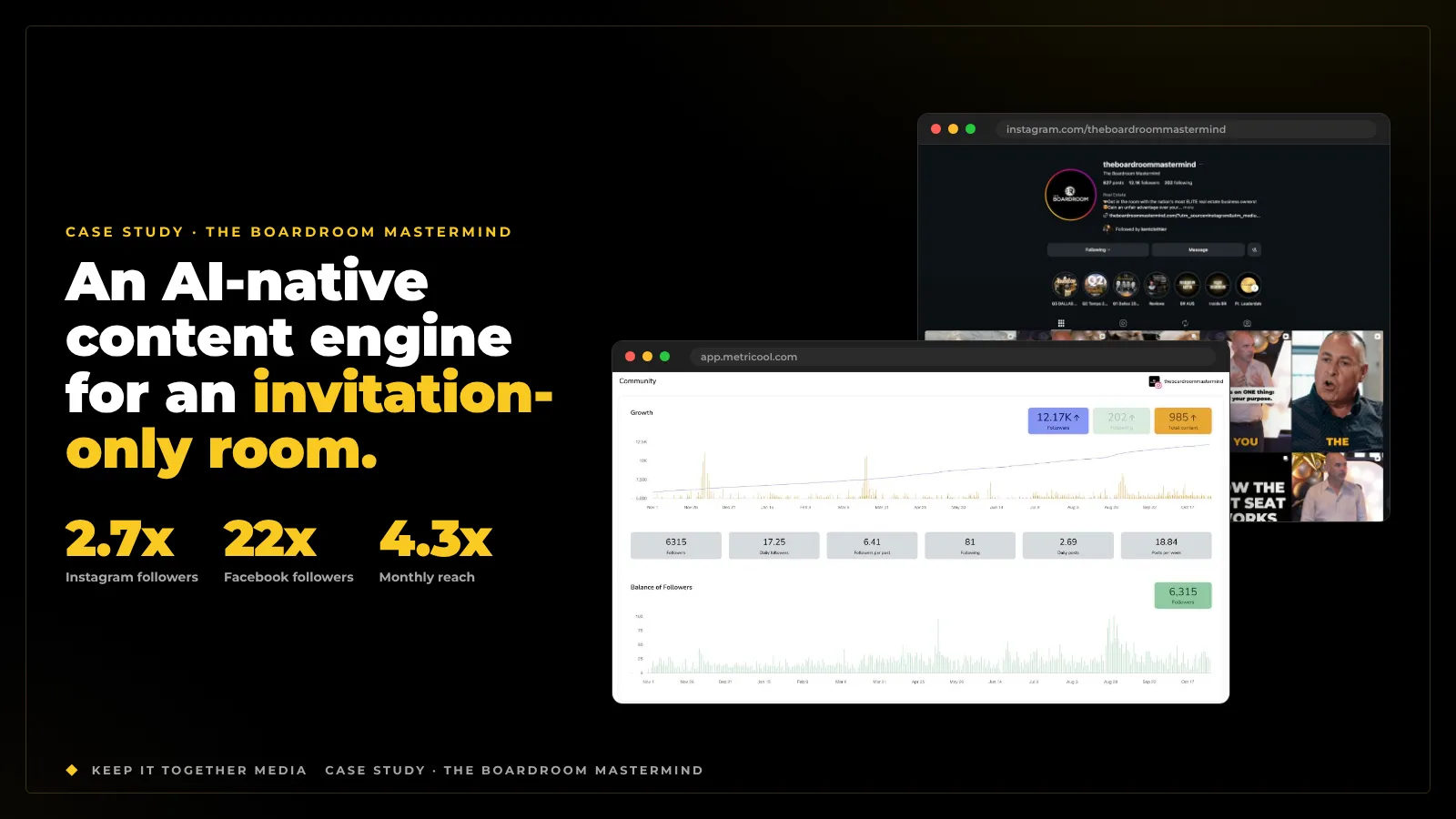
Building an AI‑native content engine for an elite real estate network
We turned a founder-led mastermind's event footage, member stories and blog archive into a seven-day, multi-network content system run by AI and approved by people.
Services: Content strategy · AI content workflows · Social media management · Video & graphic production · Performance reporting
- Client
- The Boardroom Mastermind, founded by Kent Clothier
- Industry
- Real estate, executive peer advisory
- Engagement
- February 2025 to present
- Channels
- Instagram, Facebook, LinkedIn, TikTok, YouTube Shorts
- What we did
- Content strategy, AI production pipelines, scheduling and approval workflows, performance reporting
Data as of October 31, 2026 · Metricool
Results at a glance
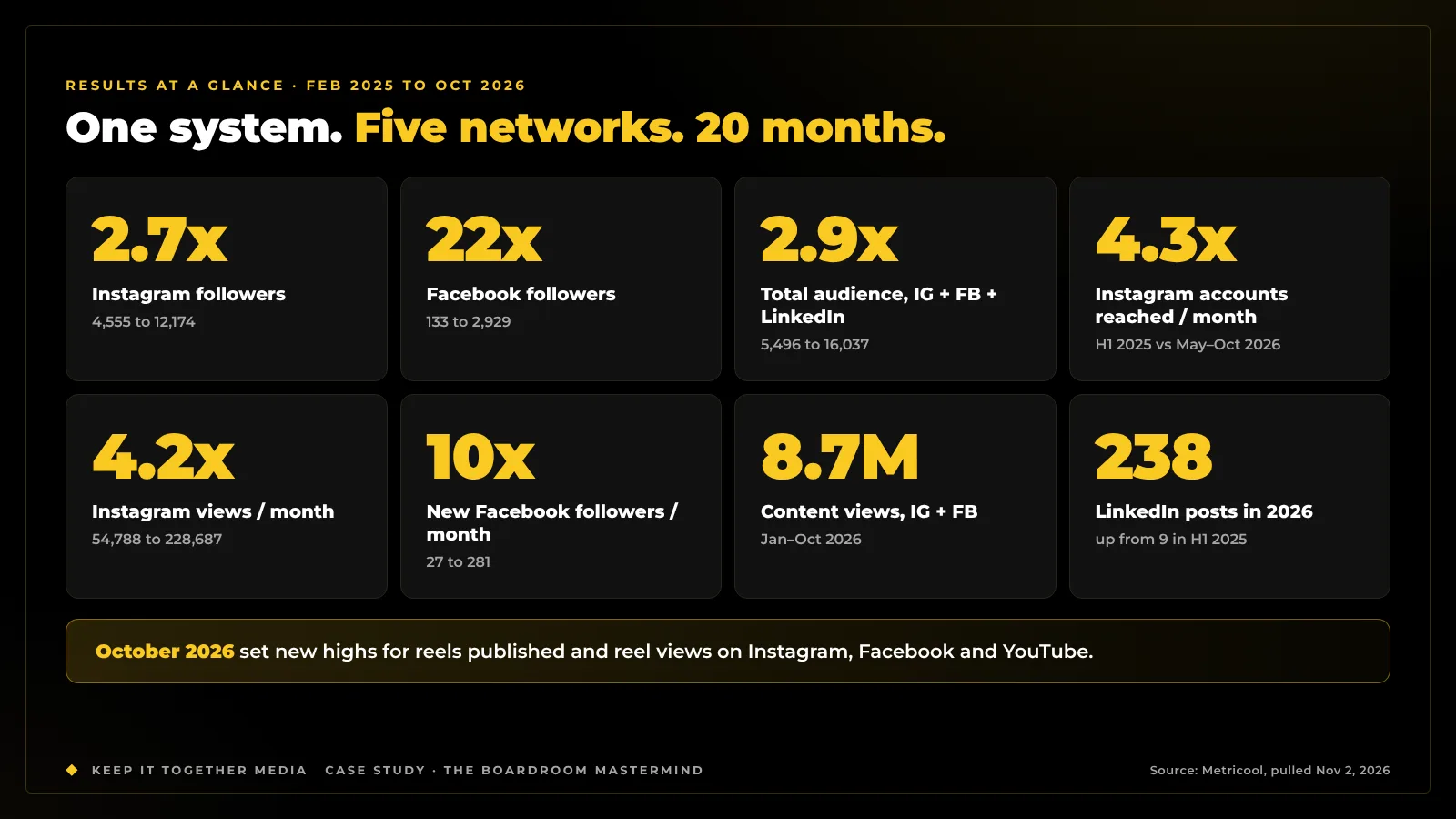
Instagram followers
4,555to12,174
2.7x (+7,619)
Facebook followers
133to2,929
22x (+2,796)
Total followers across IG, FB and LinkedIn
5,496to16,037
2.9x
Instagram views per month
54,788to228,687
4.2x
Instagram accounts reached per month
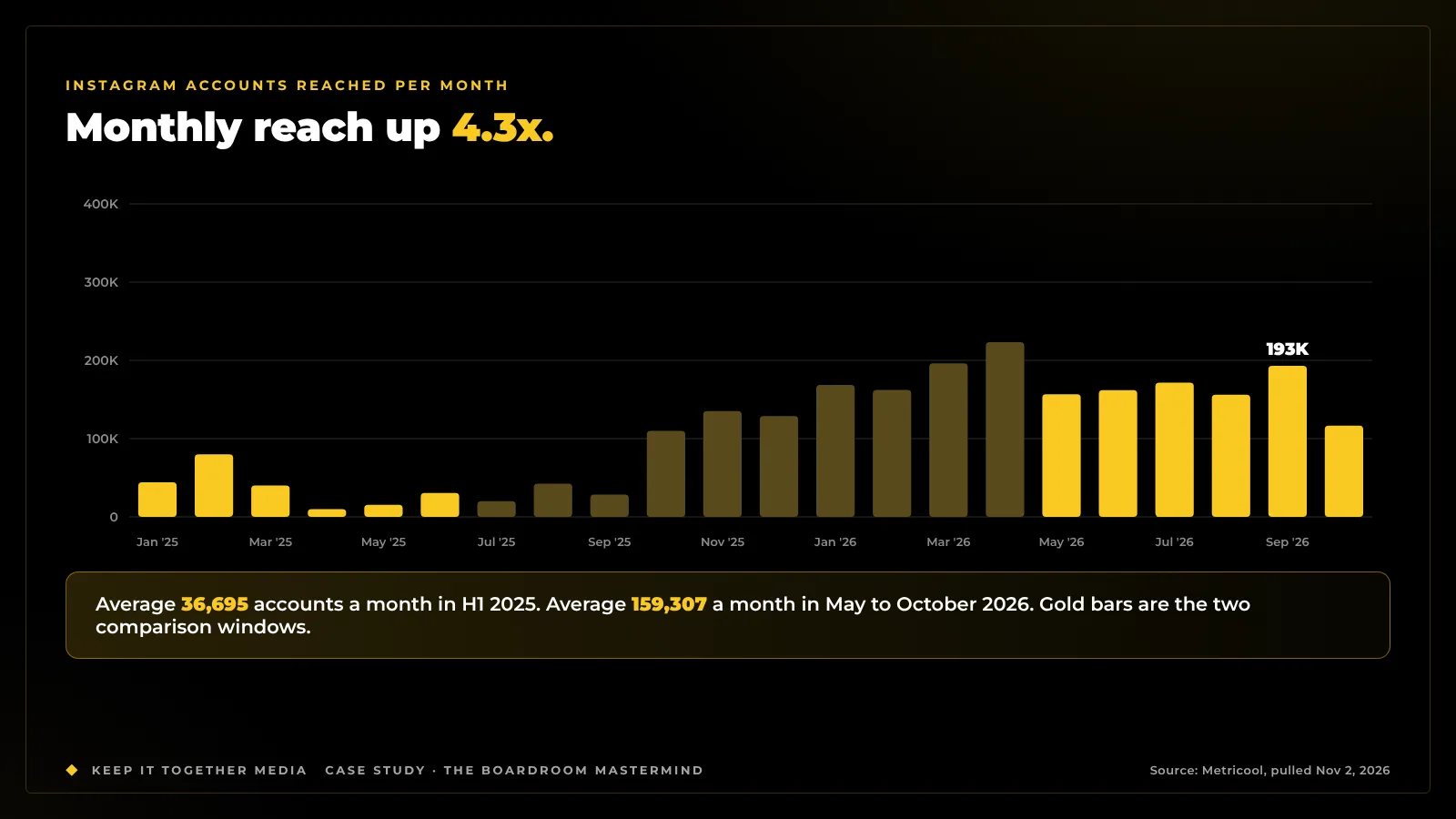
36,695to159,307
4.3x
New Facebook followers per month
27to281
10x
Instagram net follower growth per month
~130to~558
4.3x
Active channels
3to5
YouTube Shorts and TikTok launched
"Before" is the first half of 2025 (follower counts are the earliest Metricool records, Jan–Feb 2025). "Now" is May–Oct 2026 for monthly averages and Oct 31, 2026 for follower counts. Full methodology is at the bottom of this page.
8.7 million content views across Instagram and Facebook from January to October 2026.
The client
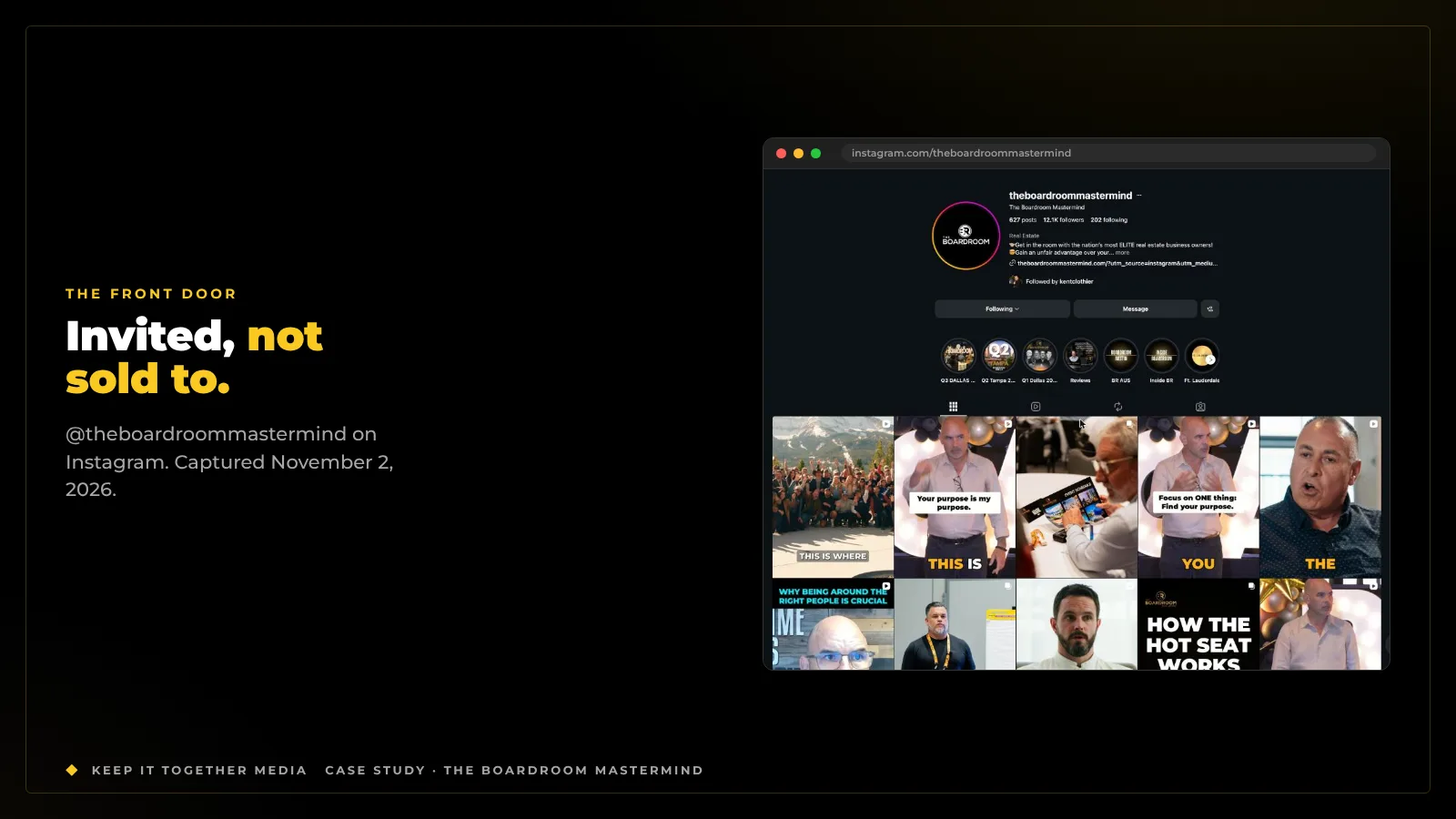
The Boardroom Mastermind is an invitation-only peer advisory group for established real estate entrepreneurs: developers, commercial investors, brokers, operators and portfolio owners who are already successful and want to scale. Founded by serial entrepreneur Kent Clothier, the group meets quarterly. Members get accepted. They don't just sign up.
That selectivity is the whole brand, and it makes marketing harder. The audience is small, senior and skeptical. Generic "real estate motivation" content repels the people Boardroom wants and attracts the people it turns away.
The challenge
When we started, Boardroom had strong raw material and no system to turn it into a steady presence:
- Great content, trapped in folders. Every quarterly event produced hours of member testimonials, hot-seat sessions, keynote clips and professional photography. Most of it never got posted.
- Inconsistent output. Posting happened in bursts around events and went quiet in between. Instagram was adding about 130 followers a month. The Facebook page had 133 followers.
- A voice that's easy to get wrong. Kent's tone is direct, high-status and results-focused. Content has to signal "invited, not sold to." One off-brand caption undercuts the caliber of the room.
- Missing channels. There was no YouTube or TikTok presence for short-form video outside Meta.
- A small team. One content manager directing, one leadership reviewer, and us. Any process that needed more hands than that wouldn't last.
The goal: put out daily, on-brand, multi-platform content without adding headcount and without giving up human control over what goes out.
Our approach
1. Strategy before software
We started with the brand. Using Boardroom's creative brief and a deep-research profile of Kent, his audience and his competitors, we wrote down the voice rules the AI would have to follow:
- Lead with proof, not promises. Show what the room did for a member.
- Keep the posture "invited." Never frame it as broke-to-rich or new money.
- Keep business models separate from asset classes. Wholesaling is never the lead.
- Every caption closes on one application call to action.
- Leadership's standing copy rules apply everywhere, from how programs are described to who appears in posts.
2. A weekly rhythm the audience can learn
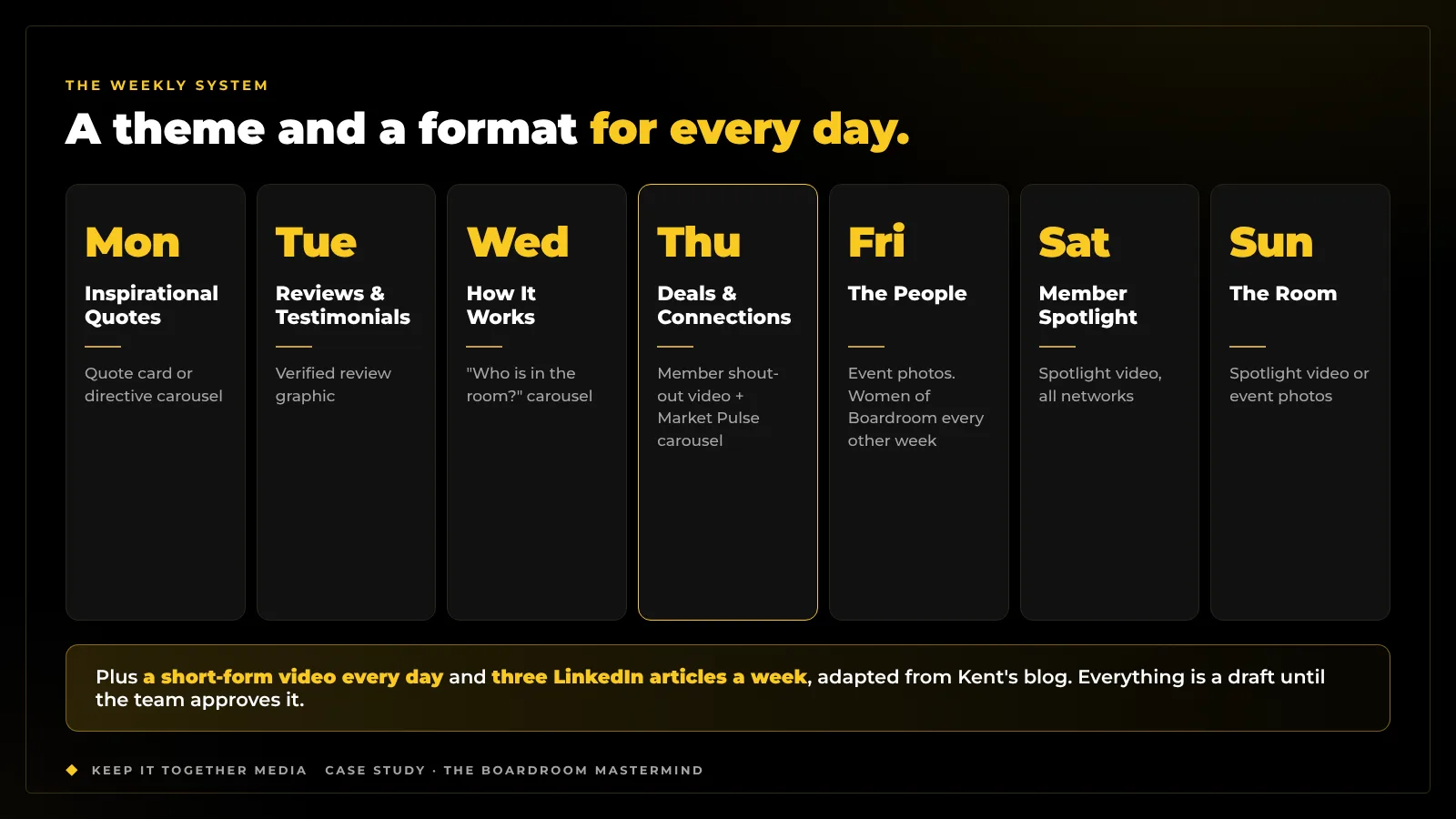
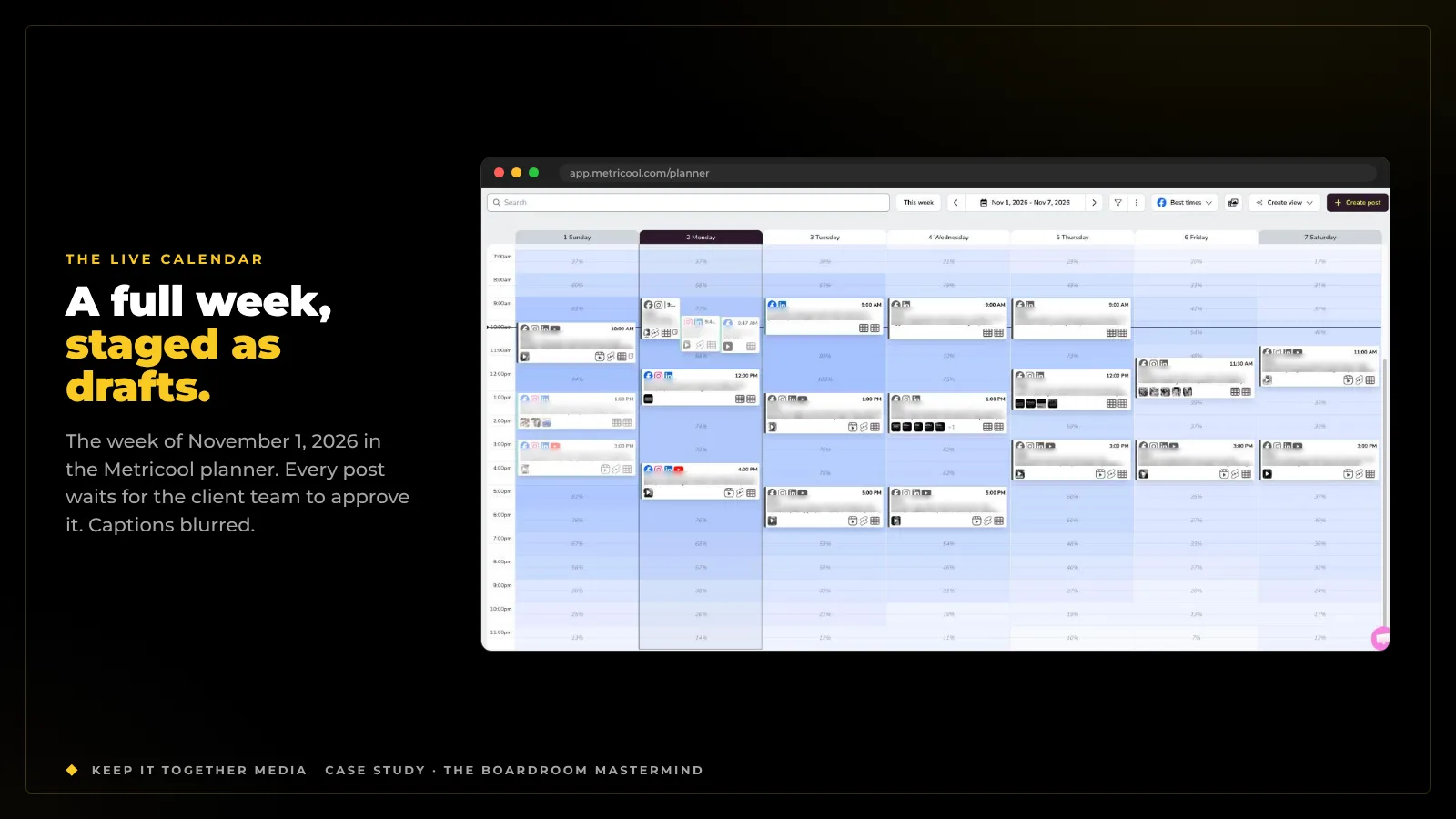
We replaced ad-hoc posting with a fixed weekly format. Each day has a theme and a format, so the team always knows what's next and the audience knows what to expect. On top of the feed, a short-form video goes out daily across the networks, and three LinkedIn articles a week are adapted from Kent's blog.
3. The AI content engine
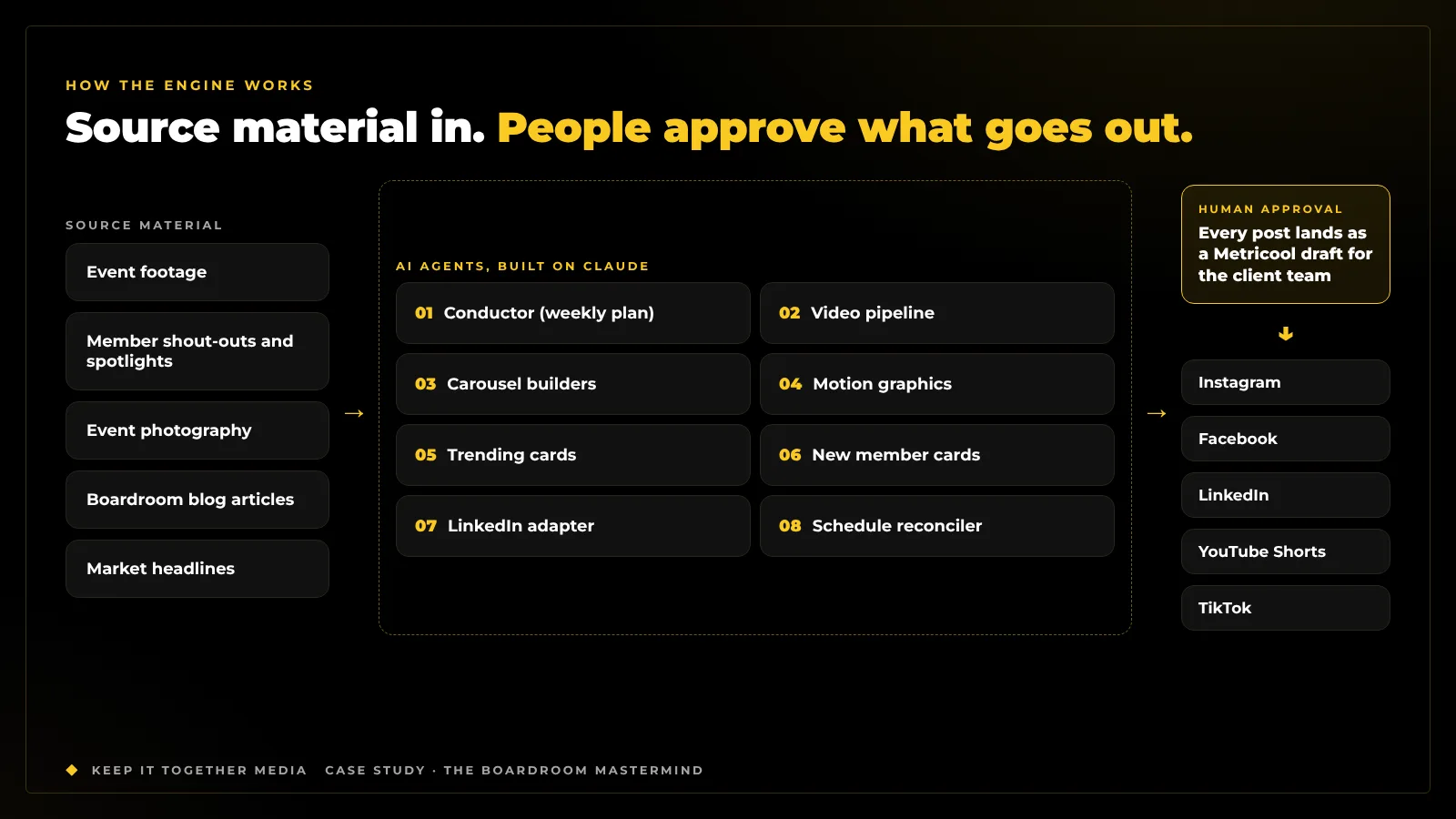
Then we built the machine. It's a custom suite of AI agents, built on Claude and connected to Google Drive, Canva, Metricool and ClickUp. Each agent handles one job in the pipeline.
| Component | What it does |
|---|---|
| Conductor | Plans the week against the weekday format and sends each slot to the right production agent |
| Video pipeline | Pulls member clips from Drive, transcribes them, and writes captions from what the member actually said. One clip becomes a Reel, a Short, a Facebook video and a LinkedIn video |
| Carousel builders | Group event photos and quote graphics into 3–5 slide carousels and mix-and-match sets for testing |
| Motion graphics | Turns a written brief into branded vertical motion-graphic Shorts |
| Trending cards | Turns a market headline or rate move into an on-brand reactive graphic the same morning, with no photo shoot. These now feed the Thursday Market Pulse carousel |
| New member cards | Produces welcome graphics in the brand system when someone is accepted |
| Reuse checker | Compares each new clip's transcript with every caption already posted in 2026, so nothing runs twice |
| Schedule reconciler | Checks the live calendar against the plan, flags gaps or off-plan formats, and fills only what's missing |
People stay in charge. Nothing auto-publishes. Every post lands in Metricool as a draft. Boardroom's content manager reviews, edits and approves, and leadership notes from weekly reviews go straight back into the agents' rules.
Each tool follows Boardroom's two visual systems: the black-and-gold parent brand, and the separate editorial look for Women of Boardroom. A Women of Boardroom design never shows up on a general post, and the reverse is true too.
4. A feedback loop, not a set-and-forget
Every week we review performance in Metricool and feedback from the client team, then update the system:
- Tactical "how-to" member videos underperformed at selling the room, so the rule changed: member videos must show what the room did for them.
- Leadership's carousel feedback (fewer words per slide, a curiosity subhead, a share-prompt closer) became a reusable template.
- Video went from Instagram-first to every clip on every network.
- In October the team's own edits became house style: no contractions, and one "why the room" line before every call to action. The agents now write that way by default.
- Weekly market-reaction graphics got a permanent home: a Thursday Market Pulse carousel, posted only while its data is still current.
The results
Audience growth that sped up
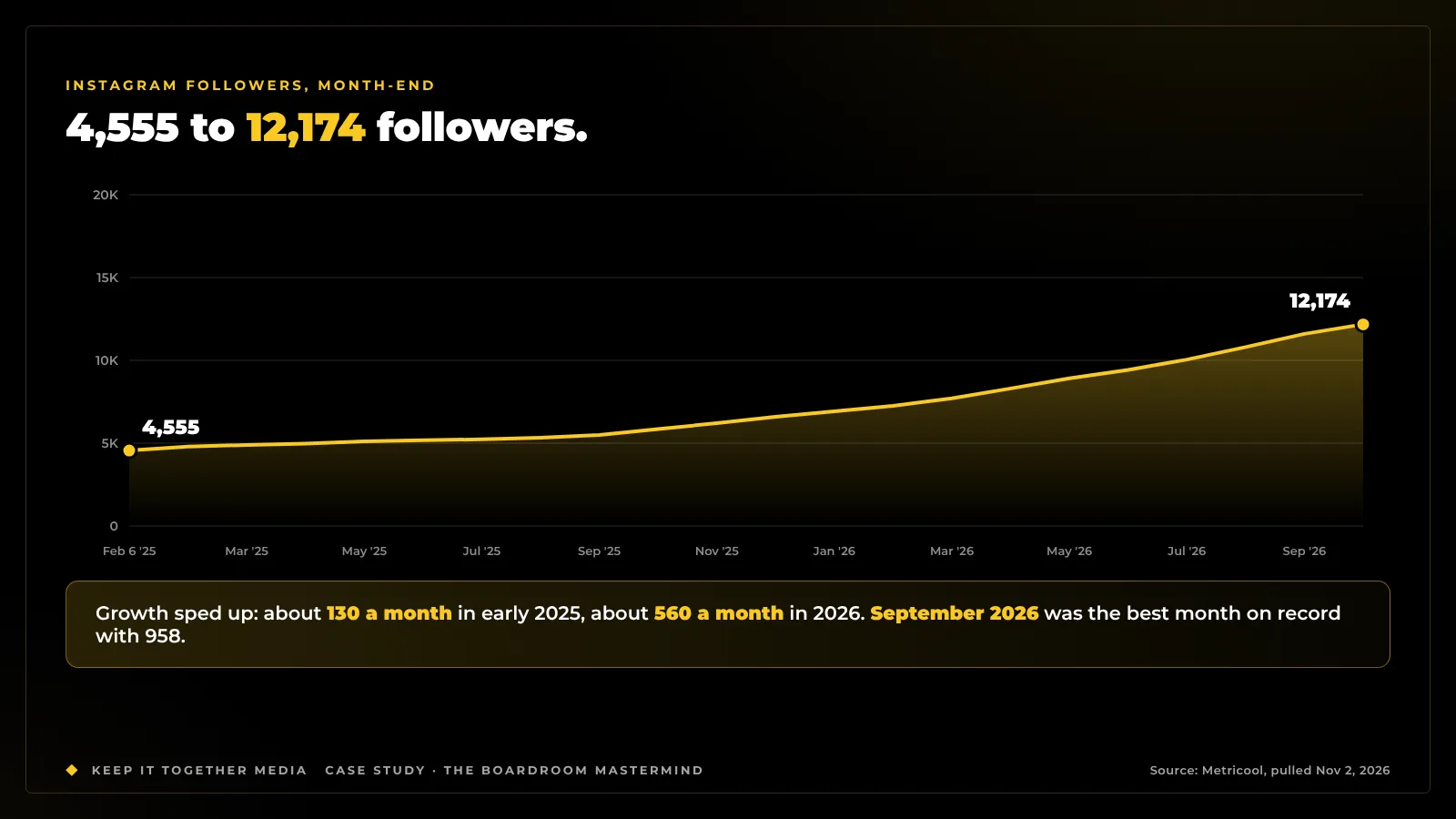
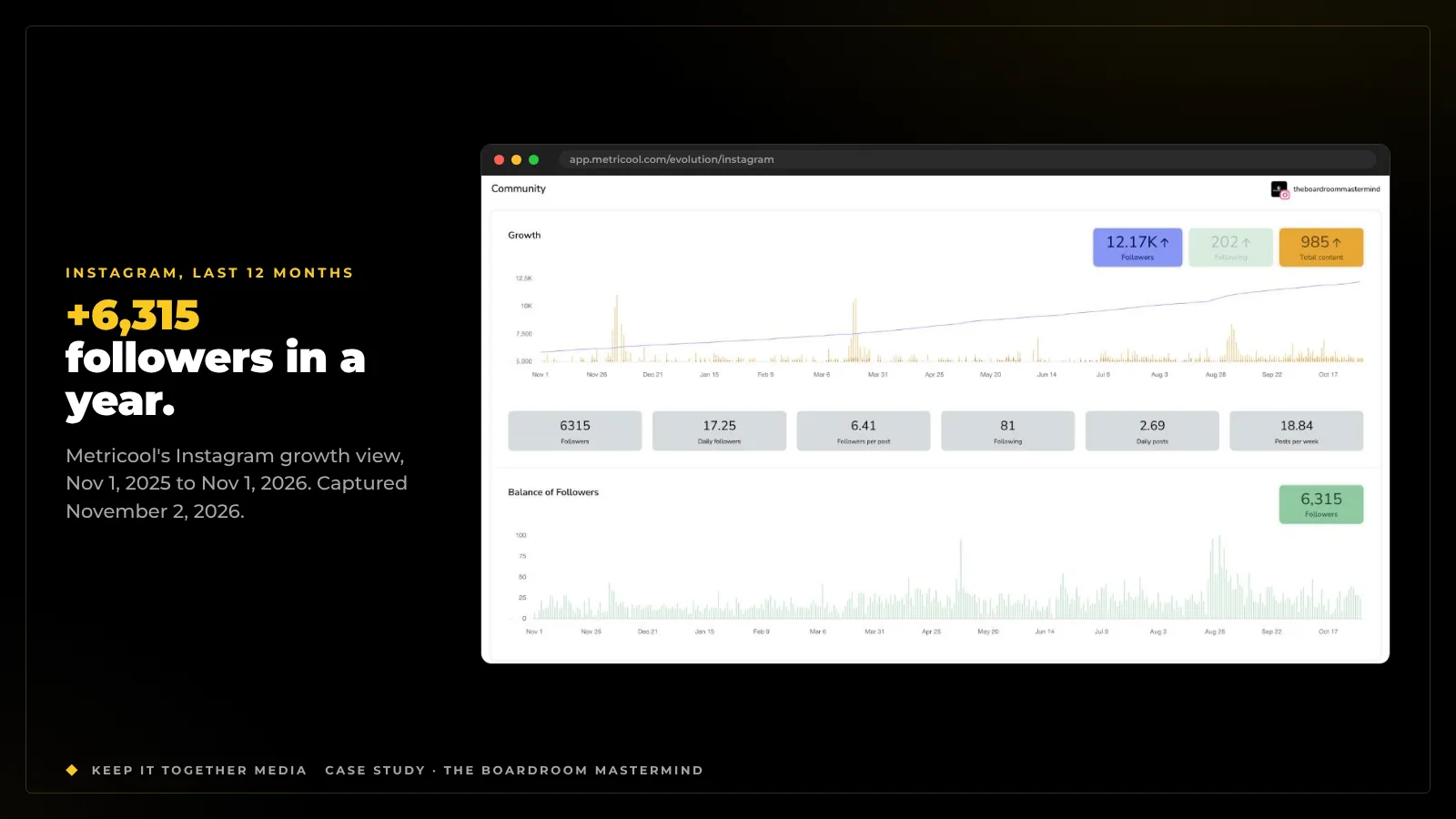
Instagram grew from 4,555 to 12,174 followers, up 167%. Growth also got faster over time. In the first half of 2025 the account added roughly 130 followers a month. In 2026 it has averaged about 558 a month, and September 2026 was the best month on record with 958 new followers.
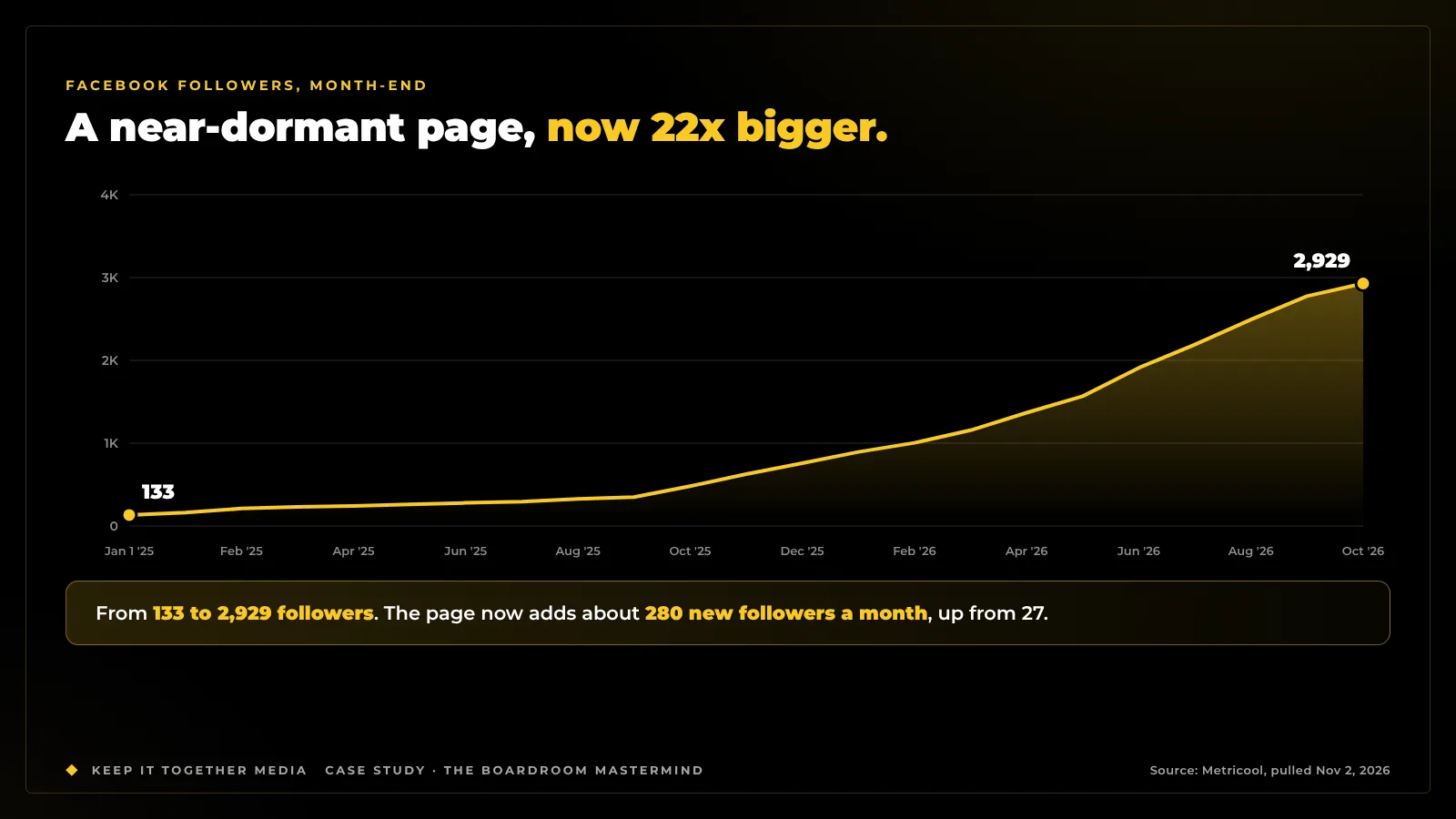
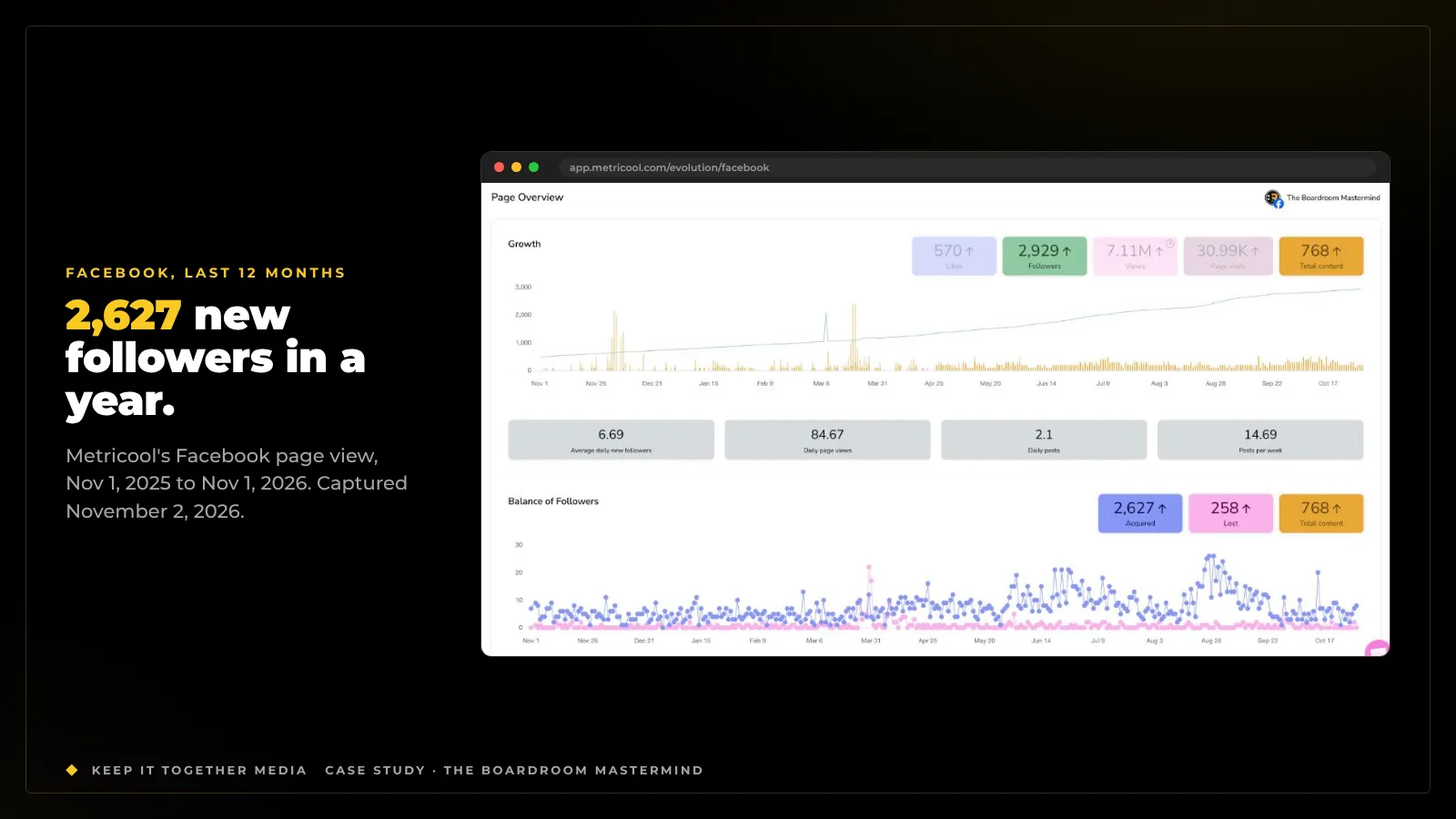
Facebook went from a near-dormant page to an active channel: 133 to 2,929 followers (22x). The page now adds about 280 new followers a month, up from 27.
Across Instagram, Facebook and LinkedIn, Boardroom's audience grew from 5,496 to 16,037 (2.9x).
Far more people seeing the content
| Instagram, monthly average | H1 2025 | May–Oct 2026 | Change |
|---|---|---|---|
| Views | 54,788 | 228,687 | 4.2x |
| Accounts reached | 36,695 | 159,307 | 4.3x |
On Facebook, monthly content views rose 52% between Q4 2025 and Aug–Oct 2026, comparing like for like under Meta's current views metric. September 2026 was Facebook's highest month on record at 805,332 views.
Video took off once it had a system
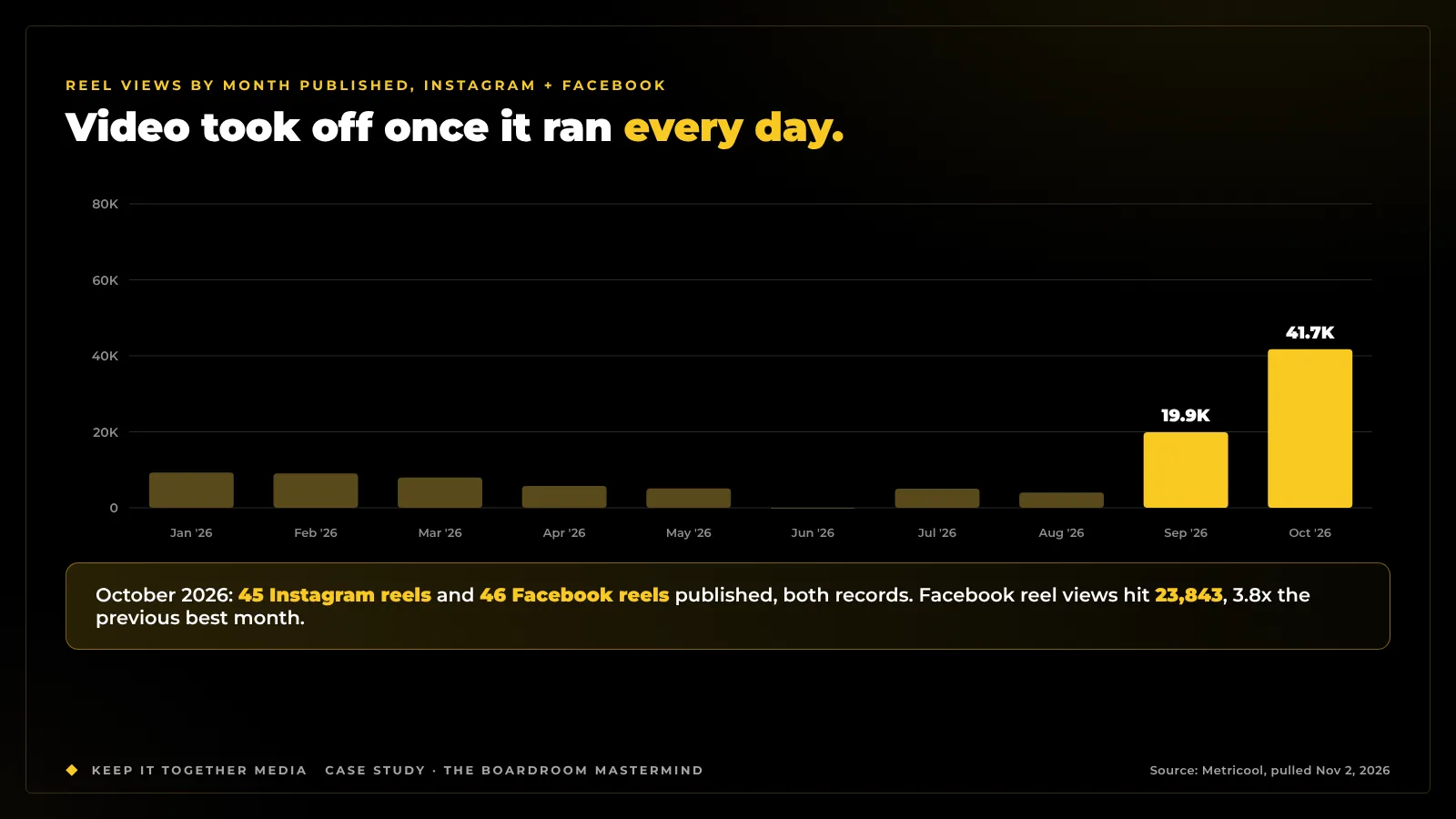
Once the video pipeline was running every day, short-form numbers moved. October 2026 set records across the board:
- 45 Instagram reels and 46 Facebook reels published, more than double any earlier month.
- Reels published in October drew 17,883 Instagram views, beating September's record of 13,555.
- October's Facebook reels drew 23,843 views, 3.8x the previous best month.
- YouTube Shorts launched from zero in late August 2026. By the end of October the system had published 65 Shorts with 11,094 views, and October alone brought 8,926.
What worked best
The top posts show what the strategy predicted. Founder insight and member proof beat generic motivation:
The traits that made you a great hustler are the same traits holding you back from becoming a CEO.
A Kent Clothier clip and the top Instagram Reel of September 2026 (2,427 views, 95 interactions). One phone call. One introduction. One building funded.
A Deals & Connections clip about a member's apartment building funded through a capital introduction in the room. The top reel of October (1,777 views). It paid for itself in the first meeting.
A member testimonial and the top YouTube Short in its first weeks. Your next deal is probably one conversation away.
A Deals & Connections clip and the #2 Instagram Reel of September (1,458 views).
LinkedIn: from dormant to consistent
LinkedIn went from 9 posts in the first half of 2025 to 238 posts from January to October 2026. Post interactions rose from about 5 a month to about 84. The follower base is growing slowly (808 to 934, +16%). The system now publishes three adapted blog articles a week to build Kent's thought-leadership presence there.
What's next
- Attribution. We're building tracked links per post and per platform so every application can be traced back to the content that drove it.
- More member stories. Member proof outperforms everything else, so we're setting up a steady supply of new shout-out and spotlight clips from every event.
- Scaling YouTube and TikTok. Member spotlights are the lead format for growing both short-form channels.
Why it worked
Strategy came first
Every agent follows written brand rules, so speed never costs consistency.
People stay in the loop
AI drafts, people approve. The client keeps full editorial control.
Assets they already had
We didn't add a production crew. We built a system that gets value out of what Boardroom already records.
Weekly iteration
Data and leadership feedback change the system every week, not once a quarter.
Methodology
All figures come from Metricool analytics for The Boardroom Mastermind's connected accounts (Instagram @theboardroommastermind, the Facebook page, the LinkedIn company page and YouTube), pulled November 2, 2026.
- Follower "before" values are the earliest records: Instagram on Feb 6, 2025 (the first available day), Facebook and LinkedIn on Jan 1, 2025. "Now" values are from Oct 31, 2026.
- Monthly averages compare Jan–Jun 2025 with May–Oct 2026. The 2026 window leaves out a short traffic spike in late March and early April 2026, so the comparison isn't inflated.
- Instagram follower growth per month is calculated from month-end follower counts.
- Facebook views are compared only from October 2025 onward, because Meta changed how it measures views around then.
- Screenshots are real captures from Metricool and Instagram taken November 2, 2026. Metricool's 12-month views run Nov 1, 2025 to Nov 1, 2026. Draft captions in the planner screenshot are blurred.
- Reel views are lifetime views of reels published in a given month.
- YouTube was connected on August 26, 2026, so its figures cover about nine weeks.
Want a content system like this for your brand?
If you're sitting on footage, photos and ideas that never make it out of the folder, we can build the engine that turns them into a steady, on-brand presence, with you approving every post.